
We built ourselves an extra brain
Last month I needed a slide deck built on one of our developers' feasibility tests. Normally that costs him half a day of interruptions: what did you test, what did the numbers say, can you check this slide. This time I asked our Brain instead. It knew what he'd tested and what came out, and it gave me the answers in words I could put straight onto a slide. He verified the result in five minutes. That was his entire involvement.
The Brain is not something we bought. It's a system we built for ourselves, and the real reason is growth. We're 40+ people and growing fast. Finding good people is hard enough; once they're in, we owe them a running start. So everyone works from the same base: quality that doesn't depend on which of us you happen to get, no afternoons spent reinventing what a colleague already solved, and new colleagues learning from everything the company has already figured out instead of starting from zero.
Not a chatbot. A memory.
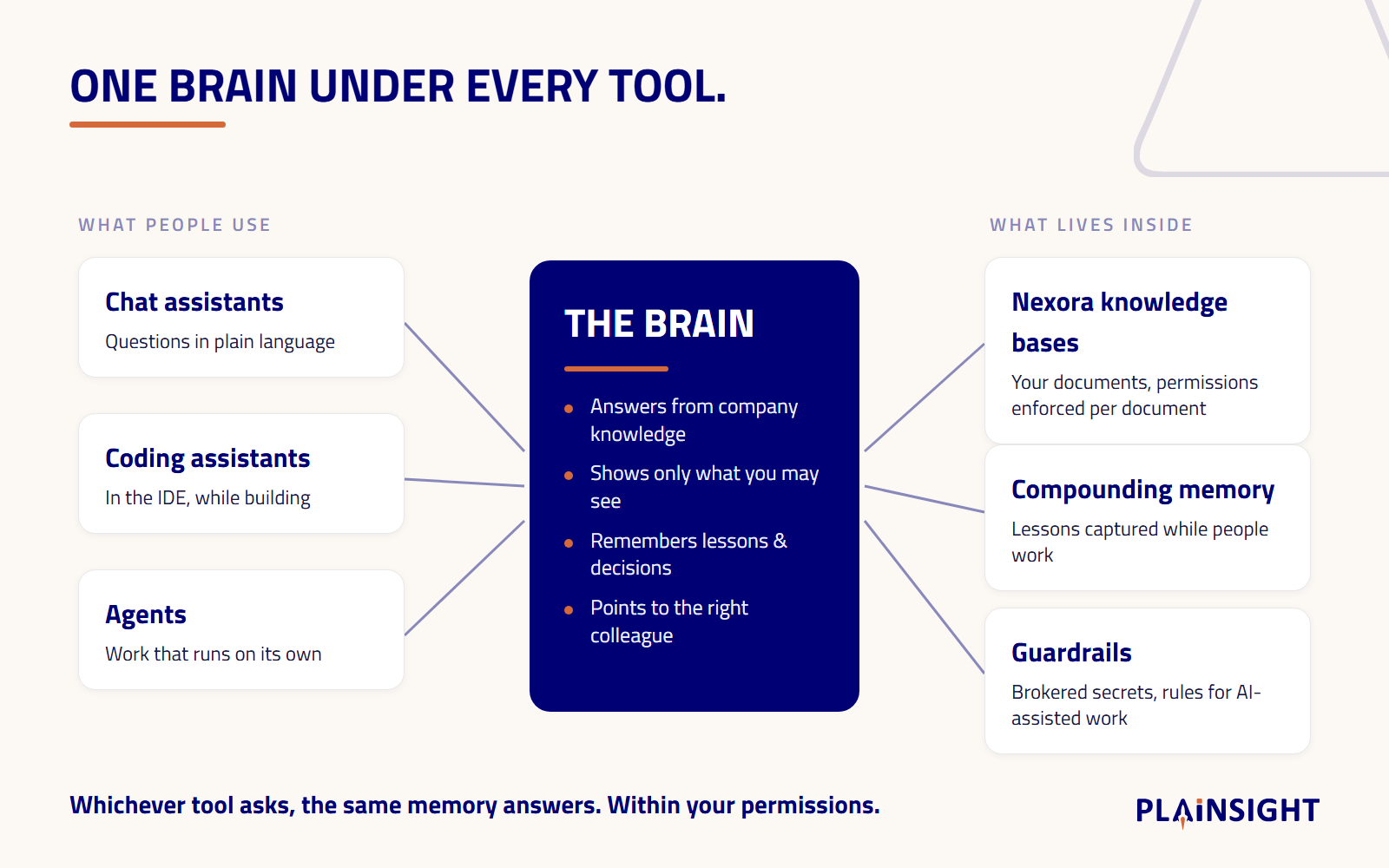
Every AI tool our people use, Claude, ChatGPT, our own secure internal assistant, the coding assistants, connects to the same layer underneath. (The plumbing is a protocol called MCP.) Whichever assistant you open, it already knows the company. Three things moved in first.
Our documents. Nine knowledge bases covering project documentation, finance, HR, sales, the works. Our knowledge-base engine, Nexora, makes them searchable in plain language, with one rule we refuse to break: the Brain never shows you a document you couldn't already open yourself. Permissions are enforced per document, not per promise.
Our lessons. This is the part I'm proudest of. When someone at Plainsight solves a hard problem, the lesson doesn't retire into their head. It gets captured while they work, and the next colleague who starts something similar gets it served automatically, before they repeat the mistake. There's etiquette to it, too. Everyone has a personal memory in the Brain that's theirs alone, pushing something into the company memory is a deliberate choice, and whatever gets pushed is judged by agents before it's stored: is it new, is it right, is it worth keeping? A memory that keeps everything is a landfill, not a brain.
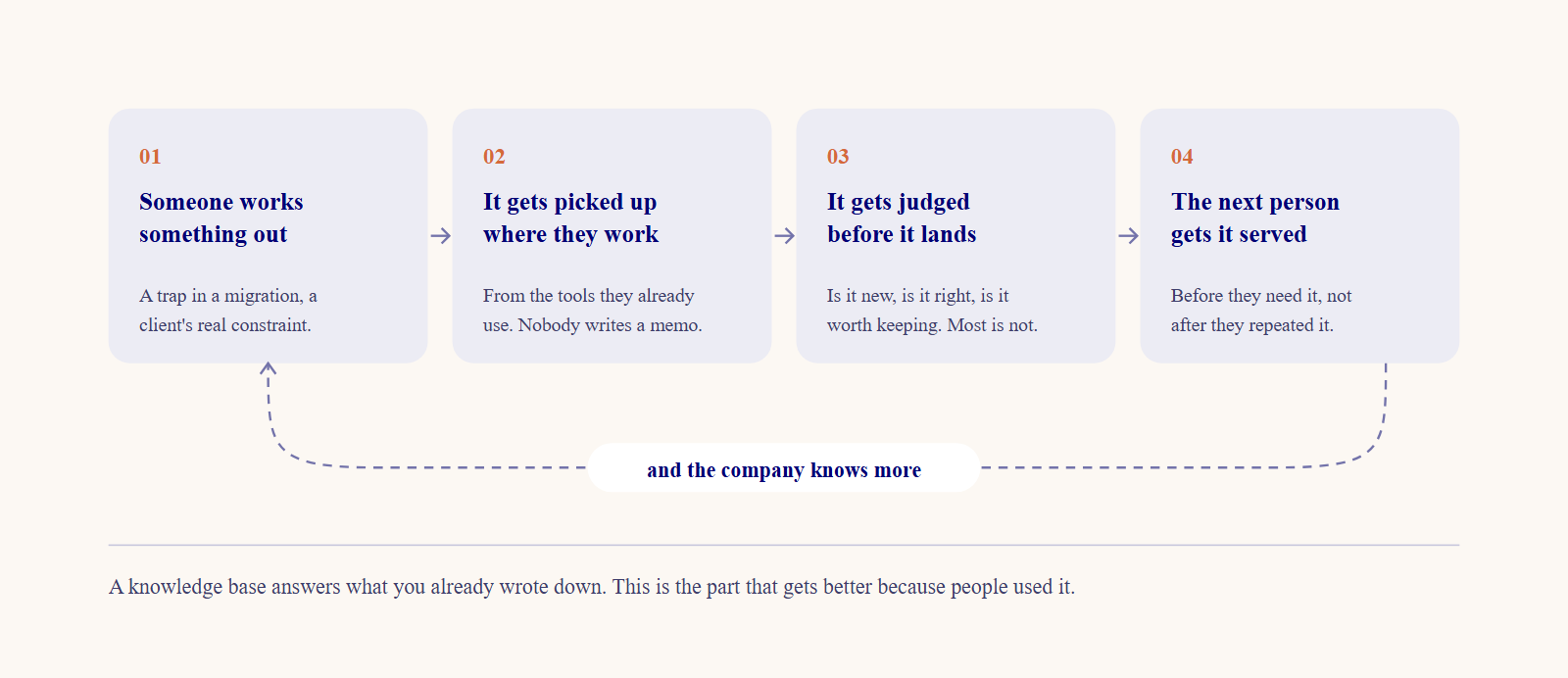
Our guardrails. The Brain brokers access to systems and secrets instead of letting them get pasted around, and it knows our rules for how AI-assisted work should happen. An assistant that knows everything is only useful if you can also trust it with everything.
What a normal week looks like
The slide deck was one Tuesday. Some others:
- A proposal needs the technical approach and the performance numbers from an application we built last year. I ask the Brain and get both in plain language, with the project documentation as source. The team lead reviews the final text instead of writing it between two sprints.
- Someone preps a client meeting by asking what we've done in that sector, which technology we used, and which colleagues worked on it.
- A developer starts a data migration, and the Brain volunteers the lesson from the colleague who hit the same trap in March. Before the work starts, not after.
- A new colleague asks how we usually run projects and gets the playbook's answer instead of five conflicting opinions.
- Someone's question runs deeper than documents, so they ask the Brain a different one: who here should I talk to about this? It knows who built what and who has worked with which technology, and it answers with a name. Sometimes the most useful thing an extra brain can do is point at a human one.
None of these are spectacular. That's the point. The value of an extra brain isn't the one impressive demo, it's the two hundred small questions a month that no longer interrupt anyone.
The part the demo doesn't show
Every demo of "chat with your documents" looks effortless: point an indexer at a folder, ask a question, applause. The searching itself is a discipline, and it's why we built Nexora, our own knowledge-base engine, rather than settling for the folder trick.
Making documents findable means reading them properly first: contracts with tables, scanned pages, presentations where the point is in a picture. Storing them so a question cites the right paragraph, not the right forty pages. Search that understands meaning as well as exact wording, in Dutch as well as English, and collapses the five versions of the same document floating around into one answer. And my favourite part: when the answer isn't there, Nexora says so, instead of confidently serving the closest noise.
Even then it has to survive scale. Two stories from our own logbook.
At one point, our own chat answered certain questions with nothing at all, while we knew the content was sitting right there in the index. Nothing was down. Two layers of the system disagreed about who was allowed to see what, and when that happens, a properly secured brain doesn't leak. It goes silent. Which is exactly what it should do, and it still looks broken. Finding and closing that gap was real engineering, not a settings toggle.
And speed. Search normally answers in about 13 milliseconds. Early on, while heavy document ingestion was running, some queries took 40 seconds. No demo will ever show you that. Your team will feel it by Tuesday afternoon.
None of this is an argument against building one. It's the difference between a proof of concept and a system people trust. The demo is the first 20 percent.
Our brand moved in too
The newest section of the Brain: our brand.
Some context. Plainsight's visual identity leans on triangles. Wireframe ones, placed in asymmetric pairs in the corners, roughly 60 percent visible, never bigger than a third of the page. Accents, not heroes. A small set of rules that makes every deck, page and carousel recognisably ours.
Now the honest part. AI tools got those triangles wrong more often than right. They filled them in. They redrew them freehand instead of placing the real files. They picked the wrong variant for the background, dropped one dead center, or blew it up until it was the slide. Every result looked almost right, which is worse than wrong: almost right means a colleague fixes it by hand, every single time.
So we treated it as what it is: a master data problem. In data work, master data is the one agreed version of customers, products and prices that every system points to, so departments stop keeping their own slightly different lists. A brand kit is exactly that, for fonts and triangles. Ours now lives in the Brain as the single source: the rules, the real asset files, the tone of voice. Every assistant that produces branded output pulls that kit first, and the result gets checked against the rules afterwards. Not "looks fine to me", but which rule broke, and where.
Since then the triangles sit where they should. And once you see a brand kit as master data, you start seeing master data all over the place: report definitions, contract templates, the project methodology. The recipe doesn't change. One master, everything points at it, and a check that tells you when something drifts.
"Can we put all our data in it?"
Every conversation about the Brain ends up at this question. The honest answer: depends on what you mean by data.
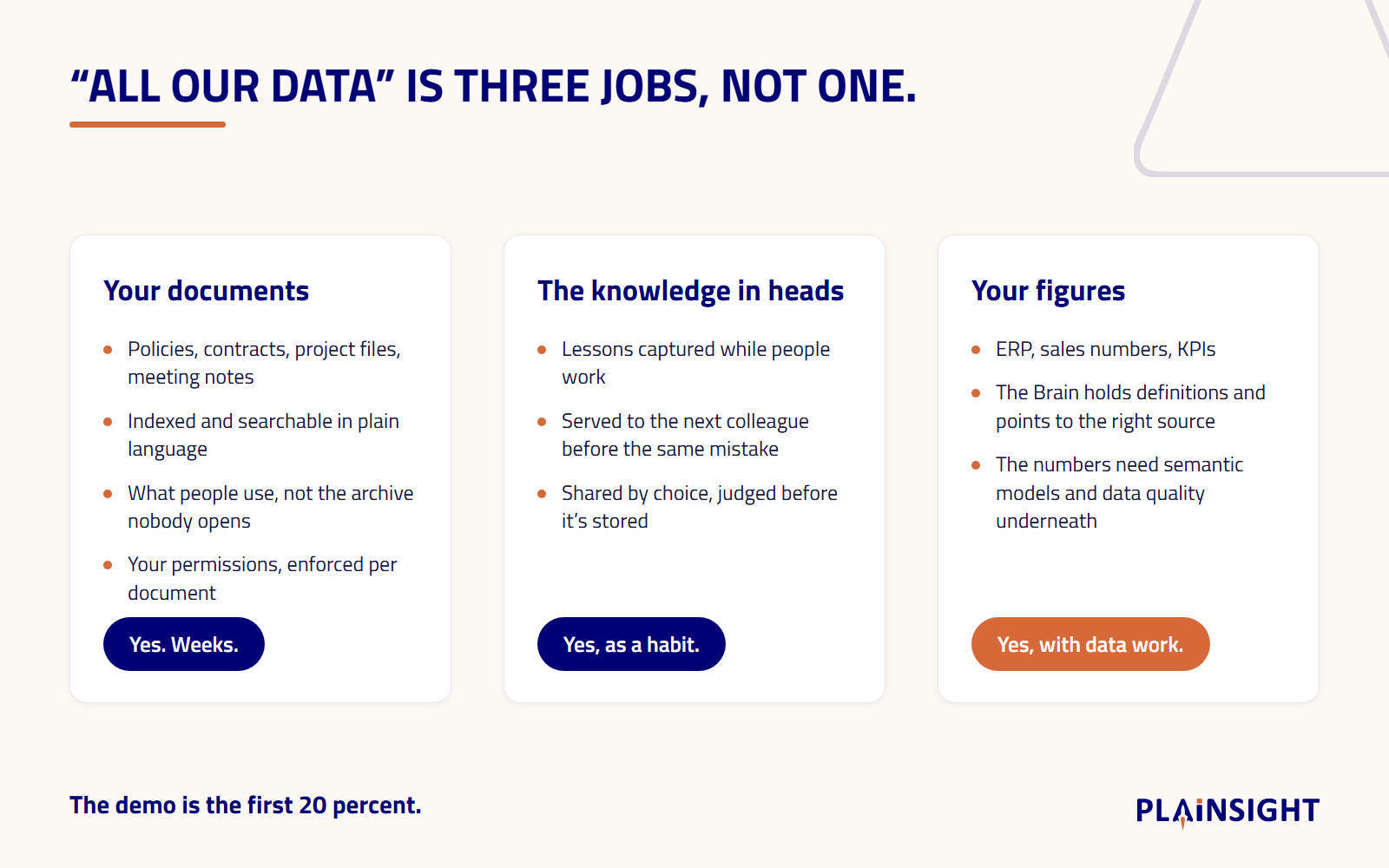
Your documents? Yes, with one caveat: be selective. Remember when data lakes quietly turned into data swamps? The same fate waits for anyone who points an indexer at everything. Most companies store terabytes nobody has opened in five years, and indexing those doesn't add knowledge, it adds noise to every answer. Index what people actually use. That's what the knowledge bases are built for, and getting there is measured in weeks.
The knowledge in people's heads? Also yes, but it's a habit, not an upload. The Brain captures lessons while people work, and that only happens if working with it is easier than working without it. That's a design problem more than a technical one.
Your figures? That answer has two halves. The Brain does help: it can hold your KPI definitions, know which report is the official one, and point you to the right semantic model instead of the export someone made last spring. What it can't do is repair what sits underneath. If finance and sales define margin differently, and somewhere in your company they do, any brain will pick one and answer with confidence. So "chat with your data" works when the definitions, the semantic models and the data quality are real. That's proper data work, it's our day job, and it doesn't come free with the document search. But once that foundation exists, the Brain is what makes it findable for everyone.
If you want one
The Brain runs in our environment, on our infrastructure, under our permissions. We built it so the same stack installs in yours.
What that honestly takes: for the document brain, a few weeks to first value. For the lessons, some habit-forming, which is culture work as much as software. For the data brain, it depends on the state of your data, and the only honest way to find out is to look at it rather than promise around it.
Want the full picture of what the Brain is and what installing one takes? See how it works. Or skip ahead: ask us for a demo and we'll show you ours.
Want to implement this in your workflow, too?

Bo Vande Sompele
Bo is co-founder of Plainsight and has been CEO since 2026. She's not a 100% person, she's a 150% person. Hand her a heavy, complex problem or a thorny strategy question and she's all the way in. Slow and halfway were never really on the menu. What pulls her is the people: helping a customer find the right answer, or watching someone on the team grow into more than they expected. She's rational about almost everything, with one stubborn exception. She backs the helpful call over the commercial one, and she's relaxed about being called naive for it.