
PRODUCTS & ACCELERATORS
Built by Plainsight
Products, not custom projects: ready to use, proven in daily work, and predictable to budget. We build them when we keep seeing the same need, and we run every one of them ourselves. The badge on each card tells you what you're looking at: a product you licence, a planner that's free to use, or a delivery framework our experts bring.
AI Assistant
One assistant for the whole company, under your control. It knows your documents and your numbers, remembers what your team learns, and takes recurring work over. Every answer shows where it came from.
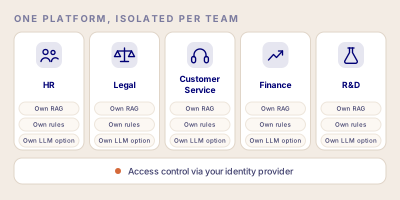
AI Assistant
One AI assistant for everyone in your company, from reception to the board. It knows your documents and your numbers, every answer shows where it came from, and it takes recurring work over once a person has approved the steps. Managed by us in Europe as the standard, or in your own environment. One fixed price for the whole organisation, no licence per user.
- Knows your company: documents, with the source, within each person's permissions
- Talks to your numbers, remembers what your team learns, takes work over
- Pick the model per department, switch any time
- Managed by us in Europe, or in your own cloud or datacentre
One assistant, four building blocks
Four things it is made of, all reached through the same chat. Each one is useful on its own, and the full story is on the AI Assistant page.
Data platform tools
Two products that keep your platform trustworthy in daily use, and two free planners to design a compliant rollout.
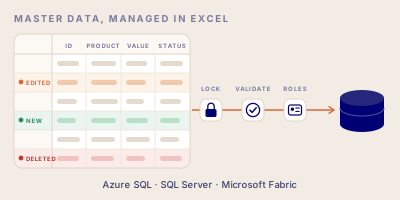
Workbook Connect
Your master data, easily managed with Excel. A lightweight add-in that lets business users browse, edit and publish data straight from the tool they already know.
- Excel add-in, familiar for business users
- Azure SQL, SQL Server, Fabric Warehouse and Fabric SQL
- Key lookups, change tracking and validation built in
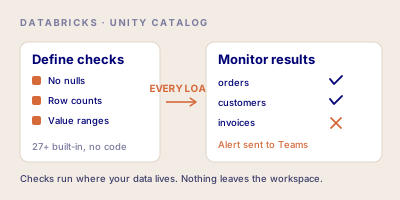
Data Quality Manager
Data quality on Databricks without the heavy lifting. Define, run and monitor validation rules against your Unity Catalog tables from a browser, no code required.
- Visual editor with 27+ built-in checks
- Runs as a Databricks Job, results on a live dashboard
- Alerts via Teams and email, data never leaves your workspace
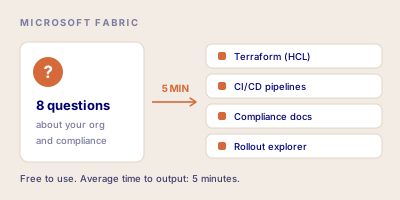

Fabric Rollout Planner
Plan a compliant Microsoft Fabric rollout in minutes, not months. Eight questions in, Terraform, CI/CD pipelines, compliance docs and a rollout explorer out.
- Eight-phase interview, adapts to your answers
- Terraform HCL, CI/CD pipelines, compliance docs
- 20+ frameworks: GDPR, DORA, NIS2, ISO 27001, EU AI Act, more
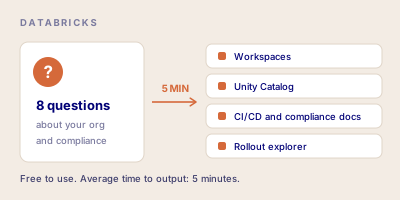

Databricks Rollout Planner
The same eight-question interview, tuned for Databricks. Terraform for workspaces and Unity Catalog, CI/CD, and a compliance justification doc, in about five minutes.
- Eight-phase interview, adapts to your answers
- Terraform for workspaces and Unity Catalog, CI/CD
- 20+ frameworks: GDPR, DORA, NIS2, ISO 27001, EU AI Act, more
Modernisation
Not something you install. A framework our experts bring along when a legacy estate needs to move.
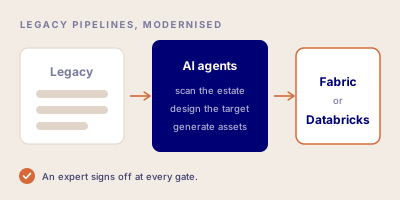
AI-Driven Migration
Autonomous in the loop, accountable at the gates. A fleet of 23 specialised agents documents your legacy SSIS, Azure Data Factory, Synapse and T-SQL estate, designs the target, then builds, tests and operates it on Microsoft Fabric or Databricks. You don't install this one: it arrives with our experts, who stay in charge where it counts.
- Estate documented in minutes, not weeks of manual inventory
- Agents iterate on their own in DEV, three human gates stay mandatory
- Terraform, lineage and quality tests as deliverables

Nothing here fits exactly?
Every product we build exists because a need kept showing up, with our clients or in the market, until building the tool was the obvious next step. Tell us what you're trying to do. That's how the next one starts.