
Ask your plant anything
A Plainsight point of view. One AI assistant across all your plant data, and what it takes to build one you can trust.
The whole paper is below, free to read. Prefer it as a document you can pass around? Ask us for the PDF and we'll email it over.
"Why did fill weights on line 2 drop after the new batch?"
Every plant has its own version of this question, and the answer usually exists already.
It is, however, spread across systems: the sensor trend in the historian, the batch log in the MES, the target in the ERP, the procedure in an SOP and the explanation in a supplier email. Collecting it takes an hour, or a call to the one colleague who remembers.
Search finds documents, not answers
A chatbot on top of the file shares returns a list of documents. Yet the same defect can have a different cause at every step of the line, so the assistant first needs the context of the question:
- Which product. The article, its family and its market.
- Which recipe or base. Learnings often sit one level below the final article.
- Which line and plant. Two plants never run the same product in exactly the same way.
- Target and actual. What the specification says, and what the line really ran.
- What was already tried. So the assistant does not repeat the last hour of work.
- Who is asking. Their role determines which sources they may see.
Miss one of these, and the answer is fluent, well written and wrong.
What a trustworthy answer looks like
Every claim links to its source. Validated knowledge, such as an approved SOP, is kept separate from experience, such as a trial report or an email. When the evidence does not cover the question, the assistant asks for the missing detail or states what it cannot confirm. The decision always remains with a person.
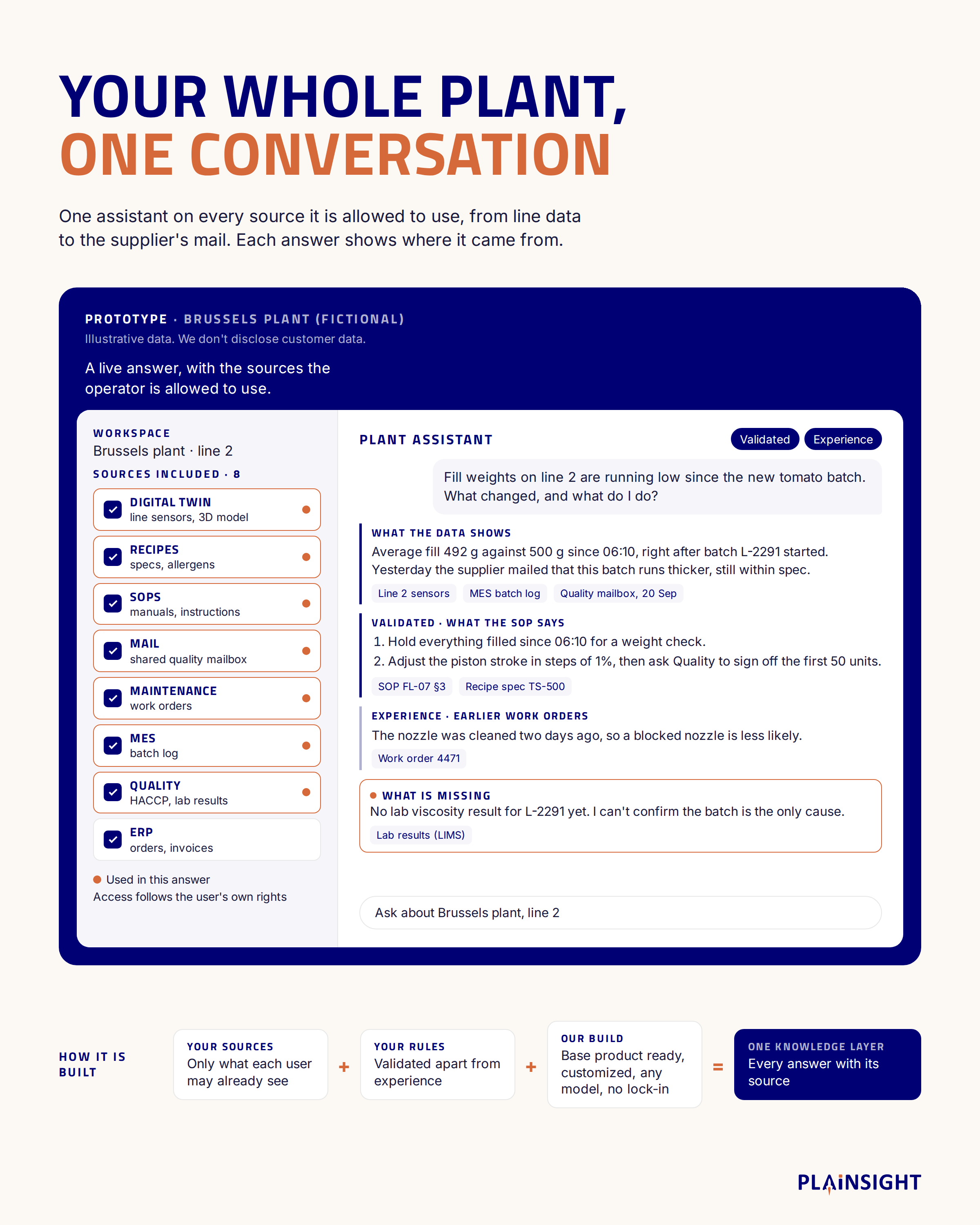
How it is built
One place to ask, a specialised agent per domain behind it, and one shared foundation underneath.
One assistant
A single entry point, in Teams or the browser. It routes each question to the right domain agent, so nobody has to choose where to ask.
An agent per domain
- R&D agent: recipes and trials
- Sales agent: specifications and orders
- Operations agent: changeovers and settings
- Maintenance agent: machines and repairs
A shared foundation, built once
- Context and ontology layer. The terms and relations your people already use: raw material, recipe, process and target, line and plant, product, problem, trial and solution.
- Control plane. Permissions from your identity provider, guardrails, monitoring, audit, cost per domain and a release gate for every change.
- Connections to your sources. Data platform, MES, ERP, historian, digital twin, documents and email. Data is read where it lives, nothing is copied out, and access rights are kept per item.
Why an agent per domain? Each domain has its own sources, instructions, test questions and owner, so answers stay precise and quality is checked per domain. Because the foundation is reused, adding a new domain takes weeks rather than a new project.
Who does what
IT and data
- Connect the data platform and the sources.
- Map identities and access rights.
- Decide which identifiers are reliable enough to link systems on.
- Run the control plane.
The business
- Choose which problems to solve first.
- Name an owner per source who decides what counts as validated.
- Define what a good answer contains and when the assistant should refuse.
- Report wrong answers so the source gets fixed.
Our take: start with one problem, not a platform
Pick one recurring problem and the people who solve it today. Connect only the sources that problem needs, and agree up front on what a correct answer looks like. Once the answers hold up, add the next problem, source or domain agent on the same foundation.
The webinar: Ask Your Plant Anything
On Tuesday 17 November 2026, we explain the principles behind one assistant across all your plant data in a webinar: why knowledge gets stuck between systems, what makes an answer trustworthy, how access follows each user's rights, and how IT and the business divide the work.
The session is intended for plant and operations managers, process engineers, R&D, quality, maintenance and sales professionals, as well as IT and data leaders in manufacturing. Register on the event page.
Want to see it on your own plant data? The assistant in this paper runs on our AI Assistant, shaped to your sources and your rules. Get in touch and we'll start with your first problem.
Keep reading
 Data Strategy
Will we soon just talk to our data?
Conversational AI finally promises real self-service analytics. Whether talking to your data gives you answers you can trust depends less on the data agent than on the foundation beneath it. A Plainsight point of view, based on the work we are doing with our first clients.
 AI Strategy
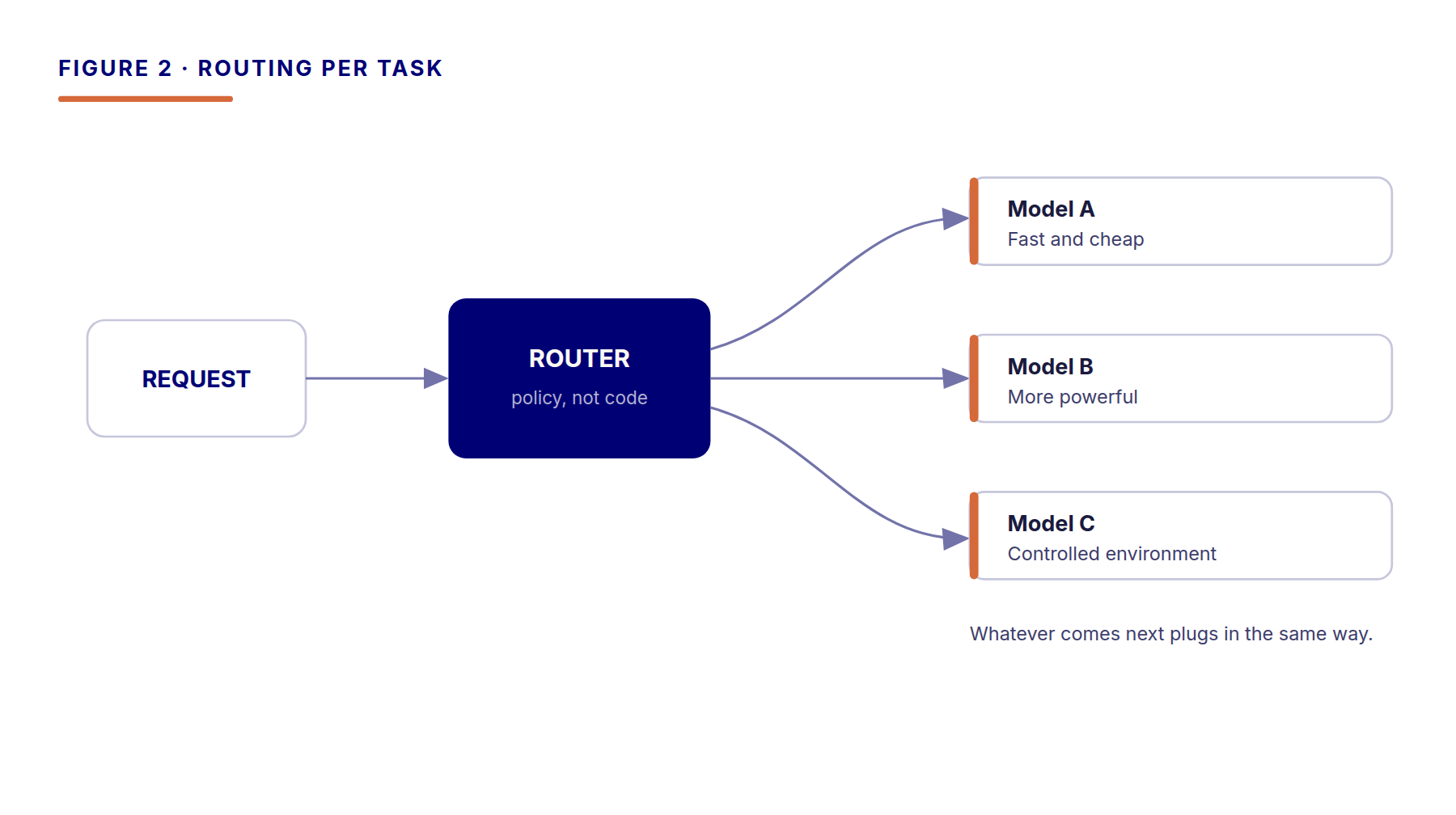
The AI model question just changed
The question for businesses is no longer which AI vendor to choose. There is no longer one obvious model for every job, and that turns model choice into an architecture decision rather than a procurement one. A Plainsight point of view.
 AI Strategy
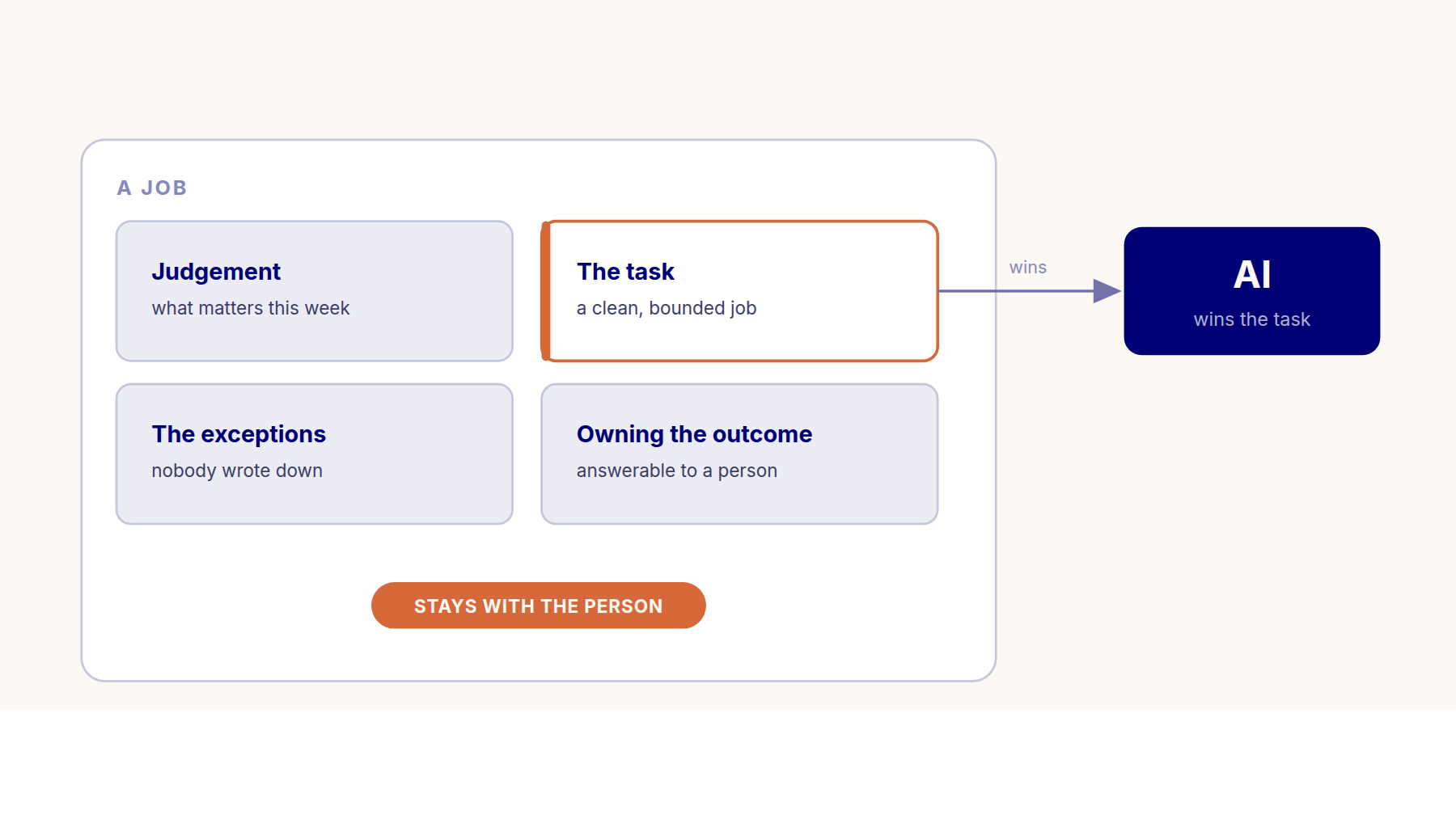
AI wins the task. You still keep the person.
Technology moves faster than people do. The gap between those two speeds is the moment we are in, and the real subject of every AI and jobs conversation.
Want to implement this in your workflow, too?

Lotte Vandewalle
Lotte brings deep experience in data and AI, with a focus on the business side: strategy, roadmaps, and making sure technical solutions actually land in practice. She studied Economics in Leuven and is at her best bridging the gap between technical teams and business leaders. Also a proud mum and a fifteen-year veteran of youth movement leadership.
Want the whitepaper as a PDF?
Leave your details below and mention in your message that you'd like the full paper. We'll email you the designed 5-page PDF, ready to share with your team.