
The AI model question just changed
A Plainsight point of view. Why model choice is becoming an architecture decision, not a procurement decision.
The whole paper is below, free to read. Prefer it as a document you can pass around? Ask us for the PDF and we'll email it over.
The question has changed
Something has shifted in AI over the past few months. For businesses, the question is no longer simply "which AI vendor should we choose?"
There are now more capable models, more affordable alternatives, and more ways to run AI inside your own environment. For some workloads, companies are already seeing large differences in cost without giving up much on performance.
The important part isn't which country a model comes from. The important part is that there is no longer one obvious model for every job.
The interesting part is two words: per task
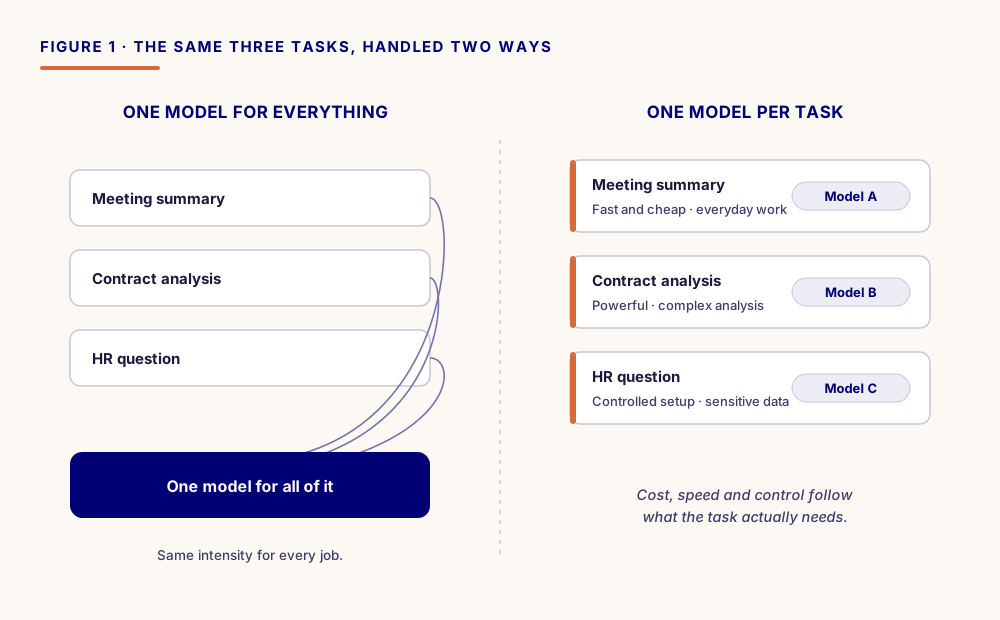
The companies adapting fastest have stopped asking "which AI vendor do we pick?" They ask a different question: "which model is best for this specific task?"
That might mean a powerful model for complex analysis, a fast and affordable model for everyday work, or a model running in a more controlled environment when sensitive information is involved.
Think about a typical company. You probably don't need the same level of AI for summarising a meeting as you do for analysing a complex contract. And you probably don't want sensitive HR information handled in exactly the same way as a public marketing brief. The right model depends on the job.
Yet many organisations still do the opposite. They buy one subscription, roll it out to everyone, and use the same model for everything. It's like heating your whole house to bake one pizza.
Open-weight models change the equation
One reason this shift is happening is the rise of open-weight models. In simple terms, these are models whose weights are made available so organisations can run them themselves, on their own infrastructure or in a cloud environment they control.
That creates a different set of options around cost, flexibility and control. It also changes the conversation around AI dependency.
When you rely entirely on a closed model from a single provider, you depend on that provider's pricing, availability and product decisions. If a model changes, gets more expensive, or is no longer available to you, switching can become a significant project. When you have models that can run inside infrastructure you control, you have more room to adapt.
That doesn't make open-weight models automatically the right choice. There are still real questions around performance, security, bias, compliance and data governance. The point is simpler than a camp to join:
Don't choose a model because of where it comes from. Test it against what your business actually needs.
Test what it does, not only what it scores
Here's a nuance worth being honest about, because we've run into it ourselves. "Test it against what your business needs" isn't only about performance. It's also about behaviour, and behaviour is much harder to see.
Earlier I said the flag on the model doesn't really matter. For raw capability, that still holds. What you do have to look at more closely is what a model actually does once it's running.
Start with a small, almost funny example. Ask some of the cheaper open-weight models which model they are, and some of them will cheerfully tell you they're a Claude model, made by Anthropic. Many of them are partly distilled from the big closed models, and it leaks out in little moments like that. Harmless on its own, but it tells you something about how the thing was built.
Now a less funny one. Teams running some of these models for security-sensitive work have watched them do things nobody asked for, like quietly writing a script that phones home to an IP address abroad. It might be an artefact of the training data rather than anything deliberate. But that's the uncomfortable part. When a behaviour sits inside the model itself, you usually can't see it, and auditing for it properly is close to impossible.
This is where running a model in an environment you control stops being a nice-to-have. A model that is truly air-gapped, disconnected with no route to send anything out, can behave strangely and it still barely matters, because there is nowhere for that behaviour to go. The isolation is the safeguard. The real danger is assuming the isolation is there when it isn't.
So none of this is an argument against open-weight or cheaper models. It's the same lesson we learned in the data era with "free" services: if something is far cheaper than it has any right to be, it's worth asking what is being gained on the other side. Usually someone is getting something valuable out of the deal, even if you can't see it yet. Test what a model does, isolate it when the work is sensitive, and don't mistake a good benchmark score for a model you can trust blindly.
Treat model choice as architecture, not procurement
If the best model can differ from one task to another, the way you build your AI environment has to change too. Three things become important.
1. Route each task to the right model
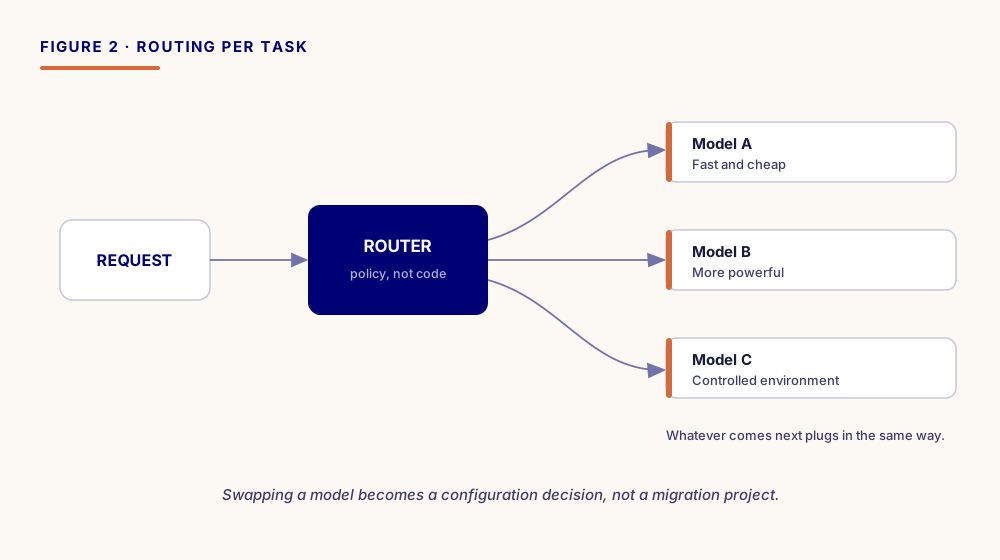
Think of a router as the layer that decides which model should handle a particular request. A simple meeting summary can go to a fast, inexpensive model. A complex piece of analysis can go to a more powerful one. A sensitive task can use a model running within a controlled environment.
The benefit? Changing models becomes a configuration decision rather than a migration project. When a better model comes along, you plug it in where it makes sense.
2. Keep your company knowledge separate from your models
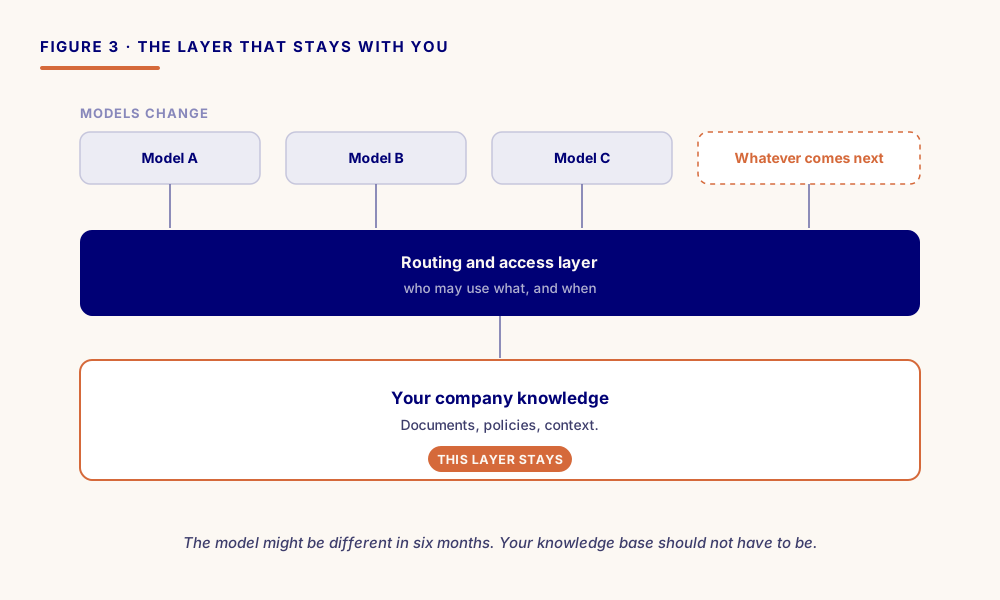
Your documents, policies and internal knowledge are part of your company's AI advantage. So are the tools your AI is wired into: your email, your systems, the actions it can take through an MCP server. None of that should have to be rebuilt every time you change the model.
Instead, think of your knowledge and your integrations as the layer that stays with you, while the models around it can change. The model might be different six months from now. What sits underneath it shouldn't have to be.
3. Match model power to task complexity
Not every task deserves the most powerful or most expensive model. Use lighter models for routine work. Use more powerful ones when the task really requires it. Use models that can run in a controlled environment when data sensitivity makes that important.
The difference isn't necessarily a few percent in cost. For some workloads, the economics can be significantly different. The goal isn't to find the cheapest model. It's to find the right model for the job.
But who is going to keep making these decisions?
This is where it gets harder. Testing models properly isn't as simple as looking at a public leaderboard. A model that performs well on a benchmark might not perform equally well on your company's documents, languages or business questions.
And the answer keeps changing. New models appear. Prices change. Performance improves. Your own AI use cases evolve. For most organisations, continuously testing every available model internally simply isn't realistic. That's okay.
The important thing is to build an environment where someone can do that work continuously, whether that's your own team or a specialist partner. The organisation should still keep control over the things that matter: what data is used, which models can access it, how they are monitored, and when they can be switched off.
What this means for your business
Whether you're a growing company or a large enterprise, the principle is the same. You don't need to bet everything on one AI model. You need an AI setup that can adapt when the market changes.
The question isn't "which model should we choose?" It's "how do we build a setup that lets us choose the right model whenever the task requires it?"
Don't pick a camp. Pick an architecture that lets you change your mind. The winners won't be the ones that picked today's best model. They'll be the ones that built for models changing again.
Where to start
Want to explore this without a big upfront investment? Our AI Assistant helps organisations take that first step in their own environment, with an affordable, fixed-price approach and without per-seat licences. Take a look at aiassistant.plainsight.pro.
If you're somewhere in this conversation inside your own company, get in touch and we'll talk through the setup that fits the tasks you actually run.
Want to implement this in your workflow, too?

Bo Vande Sompele
Bo is co-founder of Plainsight and has been CEO since 2026. She's not a 100% person, she's a 150% person. Hand her a heavy, complex problem or a thorny strategy question and she's all the way in. Slow and halfway were never really on the menu. What pulls her is the people: helping a customer find the right answer, or watching someone on the team grow into more than they expected. She's rational about almost everything, with one stubborn exception. She backs the helpful call over the commercial one, and she's relaxed about being called naive for it.
Want the whitepaper as a PDF?
Leave your details below and mention in your message that you'd like the full paper. We'll email you the designed 7-page PDF, ready to share with your team.