
From Data Products to Roadmap
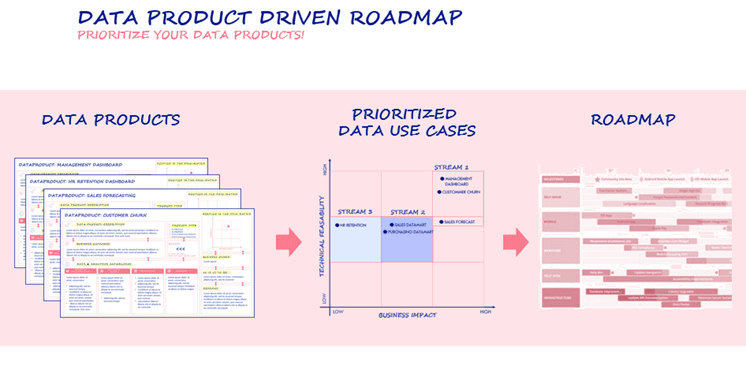
Every organization has more data product ideas than capacity to build them. The hard part is not imagining a dashboard; it is deciding which one earns a spot on the roadmap first. That is what a data product-driven roadmap solves, and the picture above shows how we get there.
Understanding the Data Product-Driven Roadmap
The journey from data product to roadmap runs through three phases:
Data Products Identification
Prioritized Data Use Cases
Roadmap Development
1. Data Products Identification
First, list what you could build. Data products are applications or tools that use data to inform decisions, provide insights, or automate work. Some examples:
Management Dashboards: a high-level view of the KPIs and metrics the organization steers on.
HR Retention Dashboards: employee retention metrics, so HR can act before people leave instead of after.
Sales Forecasting Tools: predictions of future sales based on historical data, feeding planning for the sales team.
Customer Churn Analysis: the patterns and trends that precede customer churn, so retention efforts start early.
Each product needs a clear definition: its purpose, the problem it solves, and the benefit you expect from it. A vague idea cannot be prioritized.
2. Prioritized Data Use Cases
You cannot build everything at once, so score each product on two dimensions, as the prioritization matrix in the picture shows:
Business Impact: how much the product changes operations, decisions, and overall performance.
Technical Feasibility: how complex and resource-intensive it is to build and implement.
Plot the products on the matrix and the build order starts to reveal itself. High impact combined with high feasibility goes first. (Everyone wants to start with the exciting, hard one. Resist.)
3. Roadmap Development
Finally, turn the priorities into a roadmap: timeline, resources, and milestones per product, so implementation happens in a structured, phased way that follows the business strategy.
A roadmap is not a contract. Business needs shift and new insights appear, so revisit it regularly. Its real job is giving stakeholders a clear view of the journey from concept to deployment, and keeping them informed and engaged along the way.
Benefits of a Data Product-Driven Roadmap
Working this way keeps data initiatives tied to business goals, puts your people and budget on the projects with the highest impact, and gives you a defensible answer when someone asks why their pet project is not first in line. It also pulls stakeholders from every department into the planning, which matters more than it sounds: products people helped prioritize are products people actually use.
Wrap up
Identify, prioritize, plan. It sounds simple, and the discipline of doing it in that order is exactly what keeps data teams working on the things that matter. If you want help building a data product-driven roadmap for your organization, our team is ready. Contact us to talk it through.
Want to implement this in your workflow, too?

David Loos
David is co-founder of Plainsight and has been in data and analytics for well over fifteen years. He's held every role from developer to program manager, and has led data strategy and architecture for organizations like Delhaize, VDAB, Fluvius, and Barco. He completed Vlerick's Advanced Management Programme, which says as much about how he thinks about business as it does about data.