Ads & Data · Media & entertainment
Every media type runs on its own data architecture. How do we get one view across all of them?
Up to 5x faster time to insight

Compute selection, Unity Catalog, Lakeflow ETL, Asset Bundles. The decisions that determine whether Databricks pays back its bill or just becomes the bill, made once across dozens of rollouts so you don't make them again. Plus a free accelerator that turns eight questions into Terraform, CI/CD, and a compliance doc.
BEFORE WE START
What teams already running, or considering, Databricks tell us before any work starts. Each one has a way out, and the rest of this page is how we get there.
How we approach it
All-purpose clusters left running 24/7, Photon turned on by default, fixed worker counts on bursty workloads. Most Databricks bills are paying for compute discipline that was never set up.
How we approach it
Workspace folders don't survive Git promotion. Without a repo-folder convention and a layered structure, you end up with hundreds of notebooks nobody can trace back to a pipeline or a person.
How we approach it
Notebooks moved by hand, jobs reconfigured per environment, secrets pasted into cluster envs. Asset Bundles plus Terraform-managed Unity Catalog permissions remove almost all of this work, and the human errors that come with it.
How we approach it
Catalogs without an environment convention, schemas mixed across sources, permissions clicked through the UI rather than declared in code. The result is a governed platform that still feels like a free-for-all.
Six of the patterns we apply on every Databricks rollout. Written down so you can read them before talking to us.
All-purpose clusters create resource contention and unpredictable costs. Job clusters spin up for the run and terminate automatically. Inline-defined in the job spec, never reused across pipelines, so cost and failure isolation are clean.
Photon doubles DBU cost. Worth it for heavy multi-table joins and GROUP BY on datasets above ~100 GB. Not worth it for simple ETL, data movement, or most DLT pipelines. Enabling Photon by default is the most common cost mistake we see.
Unity Catalog organised as dev / test / acc / prod at the catalog level. Bronze schemas split per source (landing_sap, landing_salesforce) for traceable lineage. Silver and Gold consolidated by domain (ads, ads_sales) to keep related transformations together.
Notebooks, jobs, and cluster configs versioned and deployed together. Validated in PR with databricks bundle validate, parameterised with ${var.warehouse_id} and ${env} so promotion is a config change, not a copy. Git SHA on every artifact for clean rollback.
Delta Live Tables for production: built-in expectations, automatic lineage, declarative dependencies. expect_or_fail() reserved for truly critical rules. Standard notebooks for ad-hoc analysis only. Auto Loader for cloud files, CDC for transactional sources.
/src and /test as top-level folders, mirrored. Notebooks named by source and table in landing layers, with f_ and d_ prefixes for gold-layer facts and dimensions. A /shared utilities folder so the same logic doesn't live in four notebooks.
Four steps. The same every time. The decisions inside each one come from doing it dozens of times, not from reading a docs page.
One real workload, one person who cares about the answer. The thing we ship in the first iteration must be useful on its own, not part of a tenant-wide migration plan.
We measure data volume, query patterns, and concurrency before we pick compute. Job clusters for ETL, SQL Warehouses for BI, autoscale ranges set against actual load. Photon only where it earns its 2x.
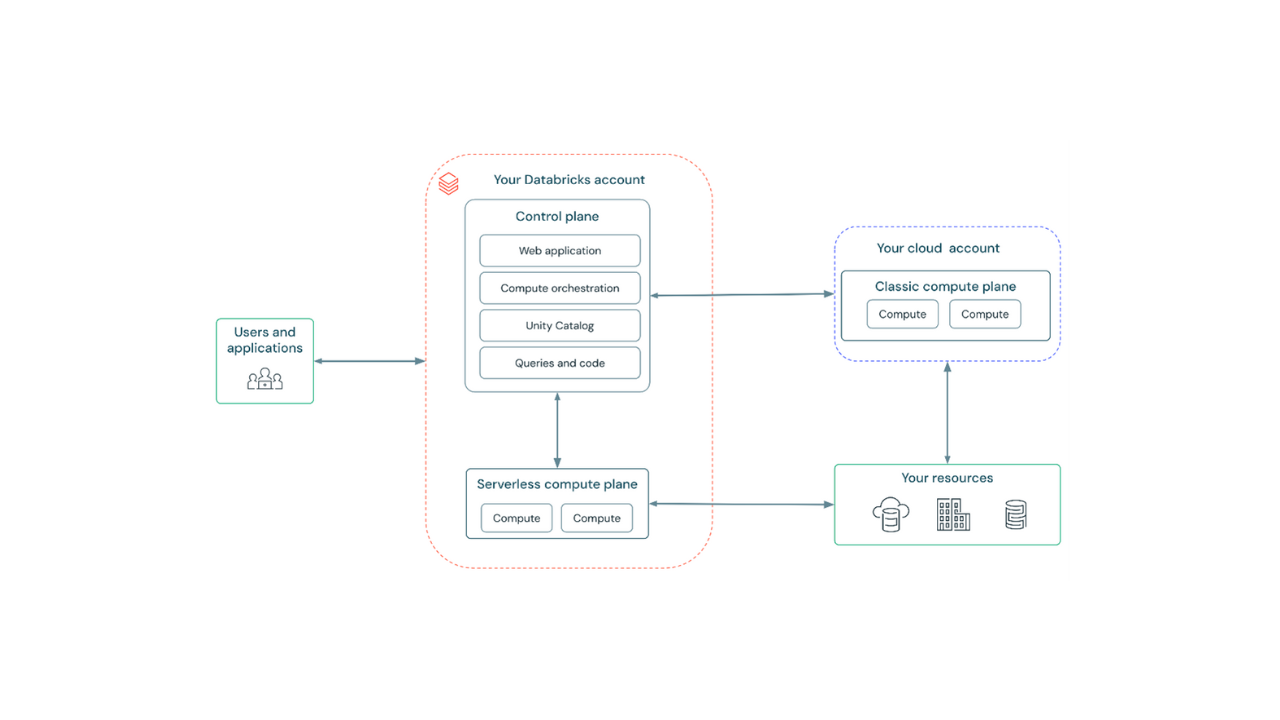
Source to Unity Catalog to Power BI or downstream consumer. DLT pipelines following the medallion pattern, Asset Bundles for deployment, Terraform for Unity Catalog permissions. The patterns we apply on every rollout.
Cluster policies, runbooks, monitoring, CI/CD pipelines. Your team runs it without us, and the next workload reuses what's already built. Docs live next to code, not in a wiki nobody opens.
We turned our rollout patterns into a tool. Answer eight questions, get Terraform, CI/CD pipelines, a compliance justification doc, and an interactive rollout explorer back. Use it as a starting point, or hand it to us to deliver.
Ads & Data · Media & entertainment
Up to 5x faster time to insight

Jacops · Construction & infrastructure
A new entity already runs on a data platform of its own, built on the Jacops foundation

Public sector
Regulatory compliance
Strategy decides if Databricks is the right pick. We build it. Experts keep it running once we hand it over.
From business questions to a data, AI and software direction your organisation can follow.
Explore →Data and analytics, AI, and custom software. Built with adoption and ownership from day one.
Explore →Specialists who think like teammates. Keep your engine running and your team growing.
Explore →Half-hour call. We'll tell you if it's the right pick for your situation, and what it actually takes to get one workload running well.
Book a Databricks chatEager to join our team? View open positions