


PGS Group
From AI strategy to working software
One of Europe's largest pallet producers set out to make AI a real strategic lever. Led from the top, driven by their own people. We took the whole journey with them, from boardroom strategy to software their teams own.
THE CHALLENGE
PGS Group has built something rare. From recovering second-hand pallets in 1993 to one of Europe's largest pallet businesses: producing, recovering, and pooling wooden pallets across 13 countries, with its own sawmills and nail factory feeding a circular model. That's not a company standing still.
But a growing administrative workload was slowing core processes and eating scarce operational capacity. Leadership didn't want a pilot to tick a box. They wanted AI woven into how the business runs, a structural lever for efficiency, driven by their own people rather than a vendor doing it to them. The hard part with ambition like that isn't the technology. It's making the right bets, getting people on board, and turning a strategy slide into something that runs on the floor and sticks.
That's where we came in.
WHAT WE DID
Leadership-led, champion-driven.
End to end, in a clear order. Awareness first, then an honest read on readiness, a strategy from the top, use cases from the people who know the work, and a build that earns trust step by step.
We start with a session for leadership and the soon-to-be AI champions, so everyone shares an honest picture of what AI can and can't do. Not a sales pitch. The ground rules for everything after.
We measured where they stood.
Before promising anything, an AI readiness scan across six dimensions: strategy, data, technology, governance, processes and people. The output is a baseline and a clear gap analysis, so what comes next is grounded in reality instead of ambition.
How the readiness scan works →Their own people picked the problems.
AI sticks when the people closest to the work choose where it goes. We ran interviews and workshops with an internal group of AI champions to surface ideas from daily processes, then scored each one on business impact, feasibility and data readiness in an app we built for it. A short list to start now, and a parked list for later. The champions keep the tool, so they can keep doing this without us.
Foundations alongside the build.
A data governance framework with owners, stewards and quality standards, and a readiness roadmap tied to the priority use cases. Trusted data isn't a nice-to-have for AI, it's the thing that decides whether any of this works.
An AI Lab, not a one-off.
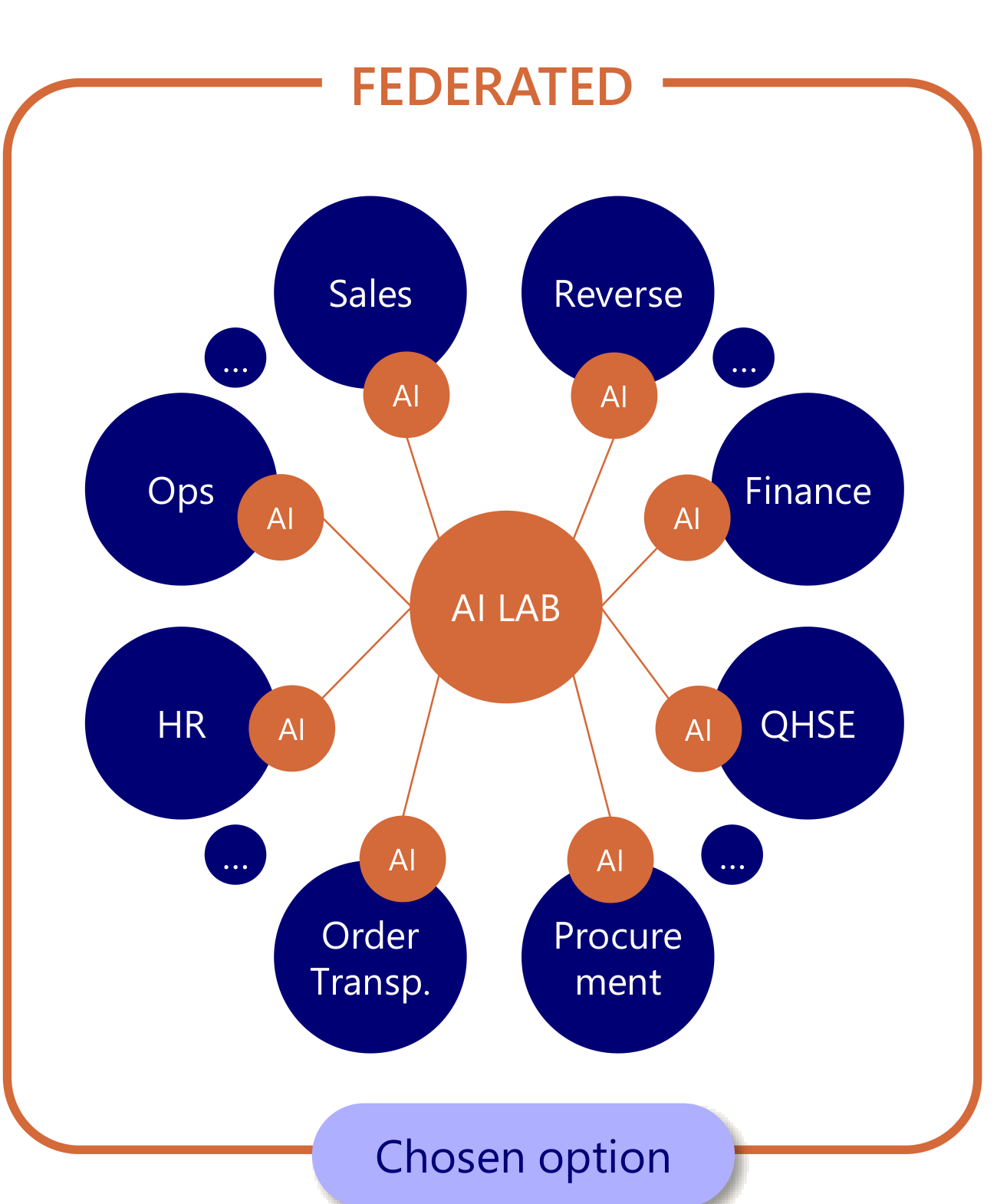
We set up an AI Lab as the structural home for this work: a federated model with a central hub close to the business, clear roles, and a community of champions embedded in every team. The goal was always for PGS to own and grow it, not depend on us forever.
WHERE TO PLAY FIRST
A roadmap, not a wish list.
Every idea the champions surfaced got scored on the same three axes: business impact, feasibility, and data readiness. Plotted against each other, the quick wins and the strategic bets separate themselves from the noise. We started with the highest-value, lowest-risk ones and sequenced the rest, ready to follow as PGS builds confidence.
Low-hanging fruit
Low impact, high feasibility
Quick wins
High impact, high feasibility
Not right now
Low impact, low feasibility
Strategic bets
High impact, low feasibility
Business impact →
HOW WE BUILD
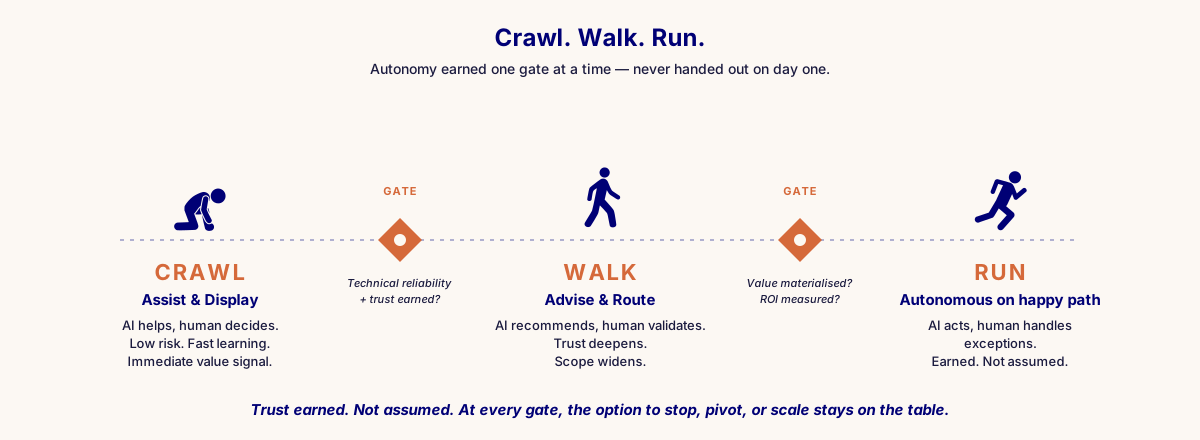
Trust earned, not assumed.
We don't hand over autonomous AI on day one. Each use case moves through stages, with a clear go or no-go at each step. First it assists and a person checks every result, then it advises and routes, then it runs the happy path on its own with people handling the exceptions. We build it alongside the team the whole way, so they own it.
WHAT PGS WALKS AWAY WITH
More than a pilot
A strategy owned at the top
guiding principles and a prioritized use-case portfolio, ratified by leadership instead of sitting in a slide deck.
Foundations that can carry it
a data governance framework with owners and quality standards, and a readiness roadmap tied to the priority use cases.
An AI Lab and a champion network
a structural home for AI, plus champions across the departments who keep finding and adopting use cases.
First use cases in production
built into the existing systems, with a measurable dent in administrative workload, and a team that can run the next one without us.
“The hard part isn't the technology. It's making the right bets, getting teams on board, and turning pilots into something that actually sticks.”
TECH & APPROACH
Stack chosen per use case. The right tool depends on PGS's context, not ours.
Thinking about where AI fits in your business?
That's exactly where we start. No pitch deck needed, tell us what you're working on and we'll figure out together if we can help.
Contact an expert