
How Decentralized Are Your Data Products?
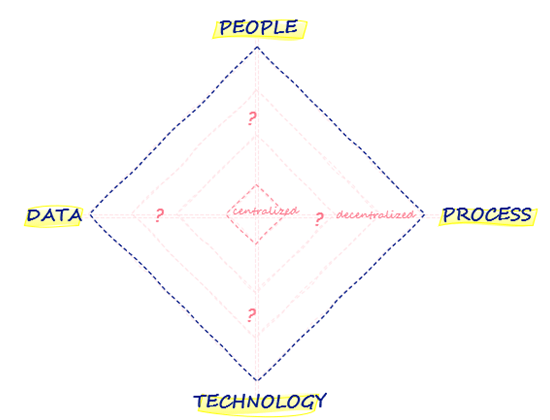
Most organizations never actually decide how decentralized their data products should be. It just happens. A central team here, a department building its own dashboards there, and a few years later nobody chose the setup you have. We help organizations build and run data products, and this question comes up in almost every engagement.
The diagram above is the framework we use to assess where you stand. It looks at four dimensions: People, Process, Technology, and Data. Each axis runs from centralized to decentralized, and your organization sits somewhere on each one, whether by design or by accident.
People
This axis is about who holds the expertise and who gets to decide. In a centralized setup, a core group of specialists handles every data question. That keeps things consistent and controlled, but it also means everyone queues at the same desk. Push responsibility out to the teams and decisions happen faster, closer to the people who feel the consequences, which makes it easier to respond when the market shifts.
Process
Processes define how data gets collected, processed, and used. Centralized processes mean standardized procedures and fixed workflows. Good for quality and compliance, less good for trying new things. Decentralized processes give teams room to shape workflows around their own needs and to move quickly when an opportunity or challenge shows up.
Technology
Here we look at how tools and platforms are distributed. One central stack is uniform and easier to maintain, but it adapts slowly while the tooling around it changes fast. Decentralized architectures let departments and projects pick solutions that fit their specific work, which tends to produce more innovation and a closer fit with actual business goals.
Data
The data itself can be centralized or decentralized too. A central repository is consistent, secure, and easy to govern. It can also become the queue everyone waits in, which makes real-time insight harder. Decentralizing data puts it directly in the hands of the teams that need it, when they need it, and that is what makes decisions data-driven in practice rather than on paper.
Finding the right balance
Decentralization is not the goal; the right balance is. Too much of it and you get fragmentation and four versions of the same KPI. Too much centralization and everything slows down. What the right balance looks like depends on your organization's goals and capabilities, and scoring yourself on the four axes shows where loosening (or tightening) the reins would help.
Wrap up
There is no one-size-fits-all answer here. The useful move is to evaluate People, Process, Technology, and Data separately and adjust each one deliberately, instead of letting the setup grow by default. Do that well and you get an organization that is more agile and more innovative, without losing control or consistency.
This is work we do with clients: assessing where they sit on these four axes and putting a fitting strategy in place. Curious where your organization lands? Get in touch and we'll walk through the framework together.
Want to implement this in your workflow, too?

Bo Vande Sompele
Bo is co-founder of Plainsight and has been CEO since 2026. She's not a 100% person, she's a 150% person. Hand her a heavy, complex problem or a thorny strategy question and she's all the way in. Slow and halfway were never really on the menu. What pulls her is the people: helping a customer find the right answer, or watching someone on the team grow into more than they expected. She's rational about almost everything, with one stubborn exception. She backs the helpful call over the commercial one, and she's relaxed about being called naive for it.