
From Insights to Impact: The Ultimate Guide to Landing Your Data Strategy
A data strategy that lives in a slide deck has not landed yet. Getting it from ambition to something teams execute every day is where most organizations lose altitude, and it is the part we spend most of our time on with clients.
The framework below shows how we approach that descent, level by level.
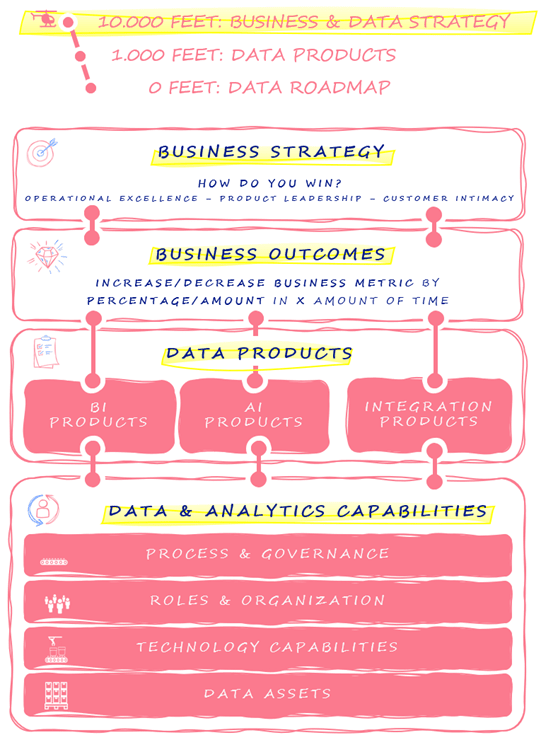
The 10,000 Feet View: Business & Data Strategy
At the highest level, business strategy and data strategy need to be one story. A data strategy written in isolation stays an IT document. Anchored to the business plan, it becomes a way to reach goals the company already committed to. That alignment is the first step to landing your data strategy.
Bridging the Gap: Data Products
At the 1,000 feet view things get concrete: data products, the tools that turn raw data into insights people can act on. We work with three types.
BI Products: Business Intelligence (BI) products cover reporting and dashboarding. They visualize data and track the metrics that matter, the instruments you fly on.
AI Products: Artificial Intelligence (AI) products use advanced algorithms and machine learning to surface hidden patterns and predict what comes next. Useful when you want to be ahead of the curve instead of reading about it afterwards.
Integration Products: the connections that keep data flowing between systems, so every part of the organization works from the same accessible, usable information.
The Ground Level: Data Roadmap
At ground level sits the roadmap: the concrete projects, milestones, and sequence that translate the strategy into work someone can start on Monday. Without it, strategy stays theory.
Achieving Business Outcomes
The whole exercise exists to move business metrics. Improving operational efficiency, boosting sales, raising customer satisfaction: whatever the target, we help clients define it clearly and track progress over time. Hitting those targets is the touchdown, the moment the strategy has visibly landed.
Building Data & Analytics Capabilities
None of this works without the underlying capabilities. Four areas matter:
Process & Governance: data governance that keeps quality, security, and compliance in order, with well-defined processes for how data is managed and used across the organization. This is your control tower.
Roles & Organization: the right people in clearly defined roles. We help clients build teams with the mix of skills and expertise their strategy needs.
Technology Capabilities: a technology stack that fits the job. We guide organizations in selecting and implementing the tools that match their specific needs, not the longest feature list.
Data Assets: knowing what data you have and keeping it usable. We help clients catalog their data so it is findable and ready for analysis.
Wrap up
A data strategy lands when every level connects: business goals at 10,000 feet, data products in between, a roadmap on the ground, and the capabilities to carry it all. That is the approach we take with every client, and it is what turns data into a working business asset instead of a promising one.
Ready to land yours? Contact us and we'll plot the descent together.
Want to implement this in your workflow, too?

David Loos
David is co-founder of Plainsight and has been in data and analytics for well over fifteen years. He's held every role from developer to program manager, and has led data strategy and architecture for organizations like Delhaize, VDAB, Fluvius, and Barco. He completed Vlerick's Advanced Management Programme, which says as much about how he thinks about business as it does about data.