
Business Only Cares About Gold -- And Why You Should Too
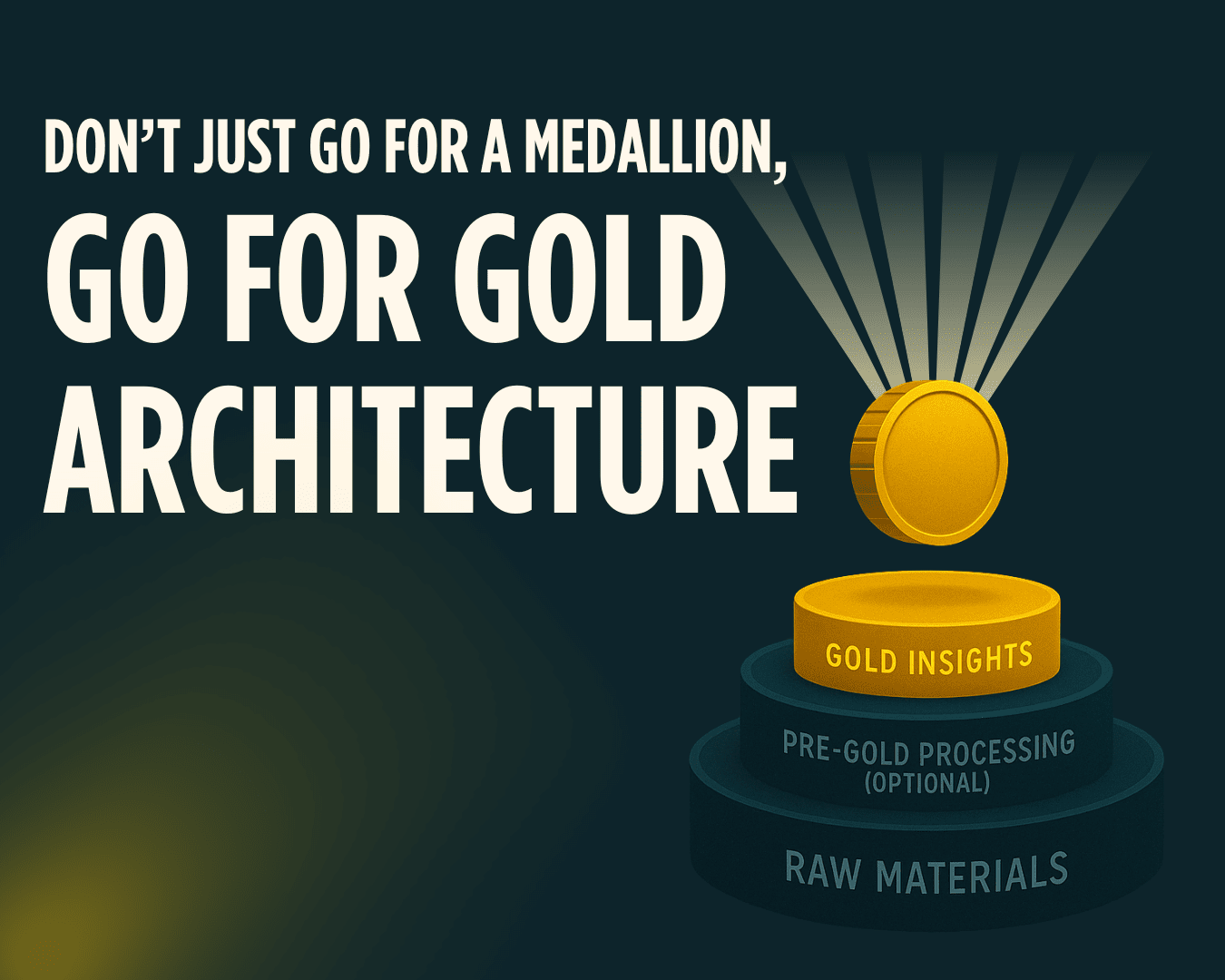
Don't Just Go for a Medallion, Go for Gold: Embrace the Go for Gold Architecture
Ask a business user which layer of the data platform they care about. It's gold. It was always gold. Nobody has ever thanked a data team for a beautifully maintained bronze layer. The Medallion architecture, with its bronze, silver, and gold layers, is a popular and structured way to manage and refine data. But every layer you maintain costs storage, processing, and attention. If you want speed and maximum value from your data, there is a simpler route that aims directly at the highest quality outcome: the Go for Gold Architecture.
What is Go for Gold Architecture?
Go for Gold is a pragmatic approach to data management with one goal: turn raw data into high-value, business-ready insights with as few stops as possible. Where the traditional Medallion architecture expects you to maintain multiple layers, Go for Gold keeps a layer only when it earns its place.
The layers:
Raw Materials: the initial, unprocessed data in its native form. Everything downstream builds on this.
Pre-Gold Processing (optional): an intermediate stage to refine and optimize the raw data. Useful when a dataset needs specific performance work before the final step. Skip it when it doesn't.
Gold Insights: where data becomes actionable, high-quality business insight. This is the layer your organization actually uses, so this is where the effort goes.
Why Go for Gold?
Fewer mandatory layers means a simpler pipeline: easier to understand, easier to implement, and fewer places for errors and inefficiencies to hide. It also means speed. Data that passes through fewer stages lands in your reports sooner, and when a decision depends on this morning's numbers, that difference matters. You duplicate less data, so storage and processing costs drop too. And the optional pre-processing layer keeps things flexible: add it for complex datasets, leave it out for simple transformations.
Comparing to the Medallion Architecture
The Medallion architecture's bronze (raw), silver (cleaned), and gold (refined) layers have their merits, especially in complex data environments where different levels of refinement are needed. The price is real, though: more complexity, higher maintenance costs, and longer processing times.
Go for Gold flips the question. Instead of "which layer does this data belong in", it asks "what does the business need, and what is the shortest defensible path to it". Intermediate layers exist only when they are truly necessary. The result is a shorter pipeline that maps onto business objectives instead of onto a reference diagram.
Implementing the Go for Gold Architecture
Start with an honest look at your current architecture: which layers and processes are there because they are needed, and which are there because the diagram had them? Then redesign your data pipeline around the essential layers, deciding case by case where the optional pre-processing layer pays for itself. During implementation, use automation and modern data tools, and make sure everyone involved understands what changed and why. After that, keep watching. Your data and your business evolve, and so does the answer to "do we still need this layer?"
Conclusion
Go for Gold is a bet on simplicity: aim straight at gold-quality data, keep intermediate layers on a short leash, and spend the saved time and budget on insights people actually use.
Don't just settle for a medallion. Go for Gold.
Curious how the Go for Gold Architecture could work for your team?
Book a free discovery session with our data experts. We'll assess your current setup and find where your pipeline can be simpler, faster, and cheaper.
Want to implement this in your workflow, too?

David Loos
David is co-founder of Plainsight and has been in data and analytics for well over fifteen years. He's held every role from developer to program manager, and has led data strategy and architecture for organizations like Delhaize, VDAB, Fluvius, and Barco. He completed Vlerick's Advanced Management Programme, which says as much about how he thinks about business as it does about data.