
Shadow AI is not the problem

introduction
AI is no longer something organisations are "considering." It is already part of daily work.
Employees use AI tools to draft emails, summarise documents, analyse data and prepare presentations. Not because they were told to. But because it helps them work faster and more efficiently.
The real shift is not about job replacement. It is about how work itself is changing.
Some activities are becoming automated or accelerated. At the same time, human judgment, context and decision-making remain essential. As AI systems take on more routine tasks, people spend more time interpreting results, making trade-offs and taking responsibility for outcomes.
The question for leaders is no longer whether AI will enter the organisation. It already has.
The real question is whether it is being steered.
What Shadow AI Is Really Telling You
In many companies, AI adoption starts informally.
An employee tests a tool.
A team experiments with prompts.
A pilot appears in one department.
This is often labelled "shadow AI" and the first reaction is to restrict it.
But shadow AI usually signals something else.
It signals that employees see value.
It signals that tools are accessible.
It signals that the organisation has not yet defined a clear path.
Blocking tools rarely solves the issue. It often pushes experimentation out of sight.
The more sustainable response is structure: clear ownership, clear guardrails and a visible place where AI can be explored responsibly.
The role of ai lab
To move from fragmented experimentation to structured capability, organisations need more than policies. They need an operating model.
This is where an AI Lab plays a key role.
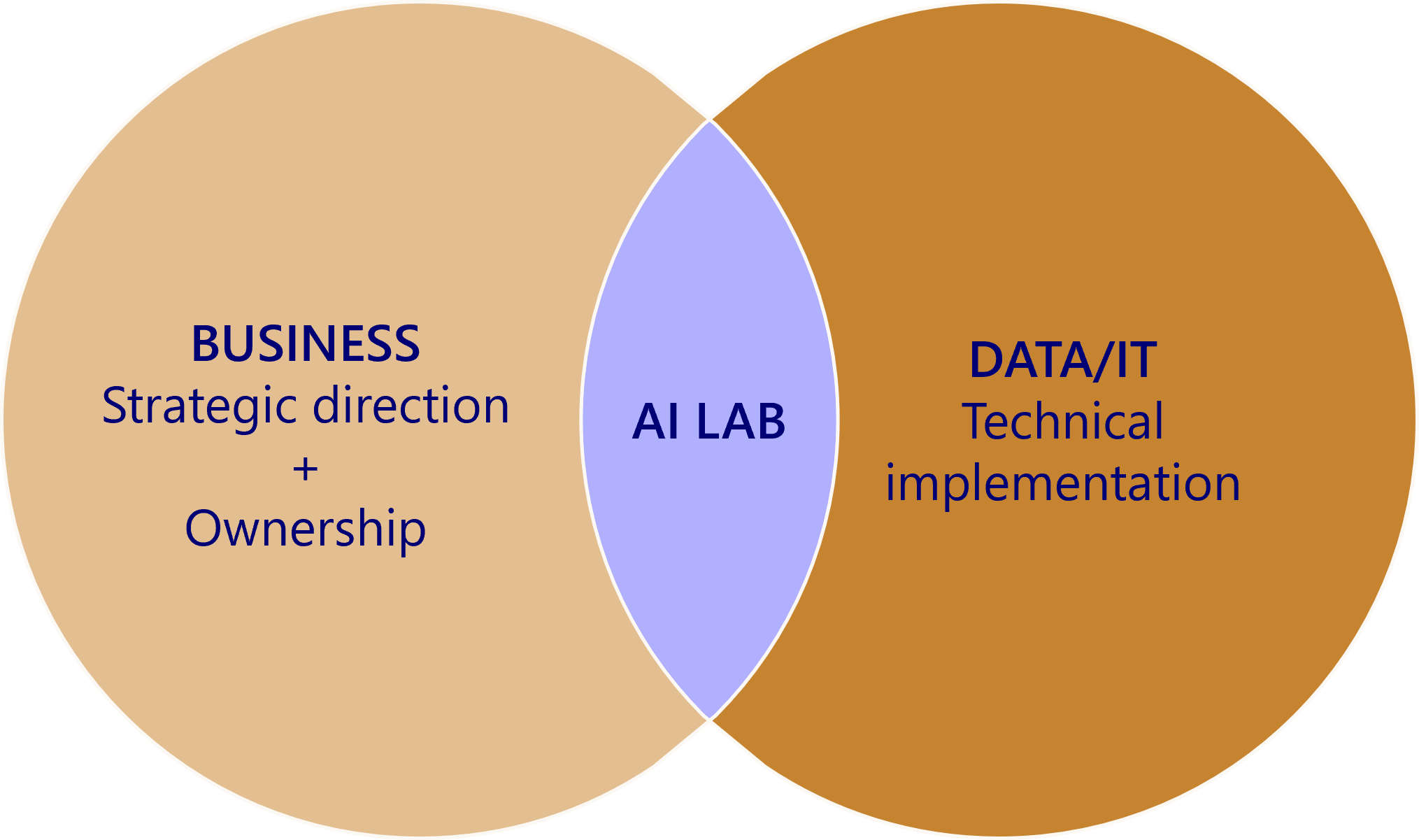
An AI Lab has two clear responsibilities.
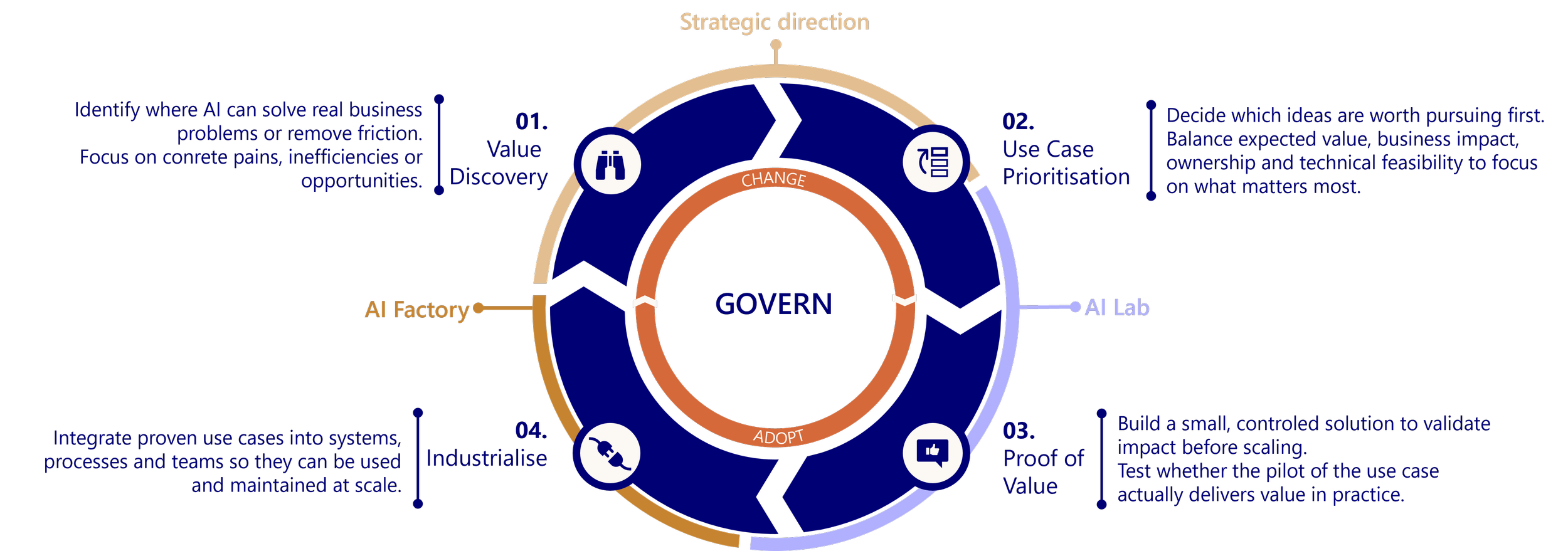
First, it industrialises AI use cases.
It identifies real business problems, prioritises initiatives based on impact and feasibility, validates them through controlled proofs of value and scales only what delivers measurable results.
This prevents endless pilots and ensures AI efforts are connected to business priorities.
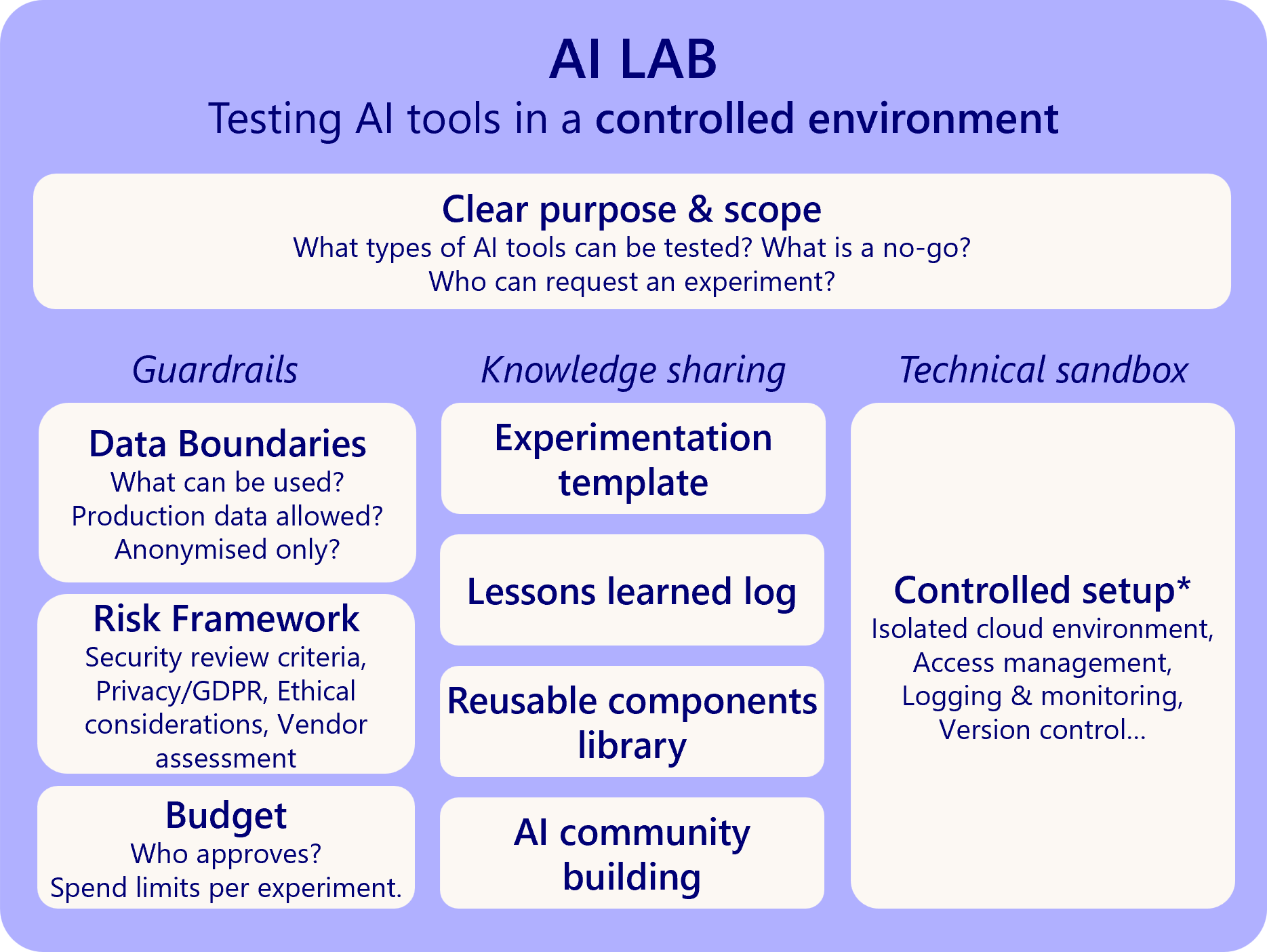
Second, it enables safe experimentation.
It defines data boundaries, approved tools and security standards. It provides a controlled environment where teams can test ideas without exposing the organisation to unnecessary risk.
When employees know where to go with ideas and what is allowed, experimentation becomes visible and manageable.
Shadow AI decreases when AI becomes structured and supported.
AI Is Changing Workflows
AI is not just automating individual tasks. It is reshaping workflows.
Customer service processes become more integrated and automated.
Data analysis becomes continuous instead of periodic.
Reporting becomes more dynamic and less manual.
As workflows evolve, roles evolve as well.
Employees spend less time preparing first drafts and more time framing questions.
Less time collecting information and more time interpreting it.
Less time executing steps and more time overseeing systems.
The focus shifts from doing everything manually to guiding, reviewing and improving AI-supported processes.
Skills Are Evolving, Not Disappearing
AI does not eliminate most skills. It changes how they are applied.
Analytical thinking, communication and problem-solving remain essential. But they are used in different ways.
Employees increasingly need to:
Ask the right questions
Assess the reliability of AI outputs
Translate insights into decisions
Understand risks and limitations
Work closely with technical teams
AI fluency " the ability to use and manage AI tools effectively " is becoming a baseline capability in many roles.
At the same time, complementary skills such as process optimisation, governance, quality assurance and change management are gaining importance.
Routine work may decline in some areas, but human judgment, negotiation, coaching and strategic alignment become even more valuable.
Governance as an Enabler
As AI becomes more embedded, governance becomes more important.
But governance should not slow progress. It should enable responsible scaling.
A practical AI structure typically includes the following components:
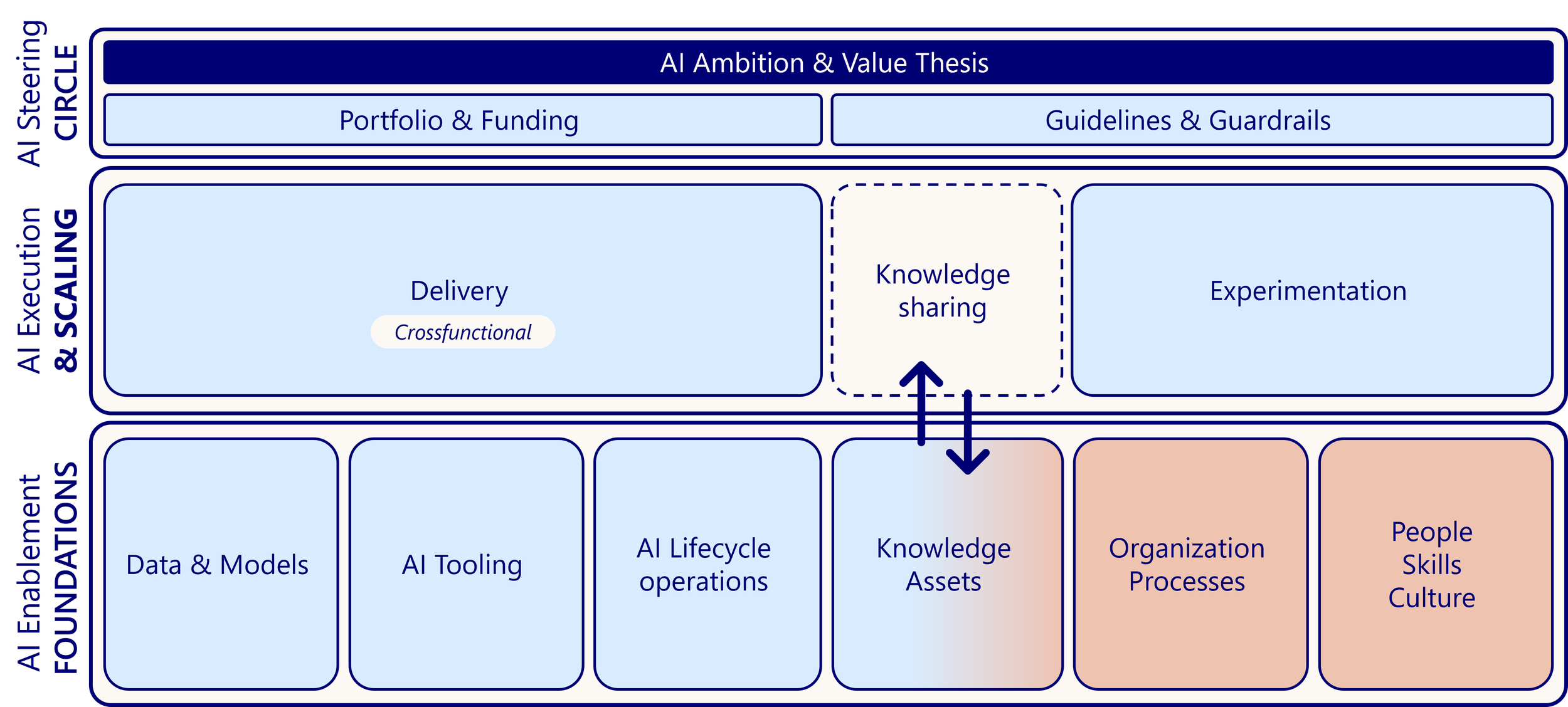
At the top, a clear AI Ambition & Value Thesis that defines how AI supports business priorities and where it should create value.
Supporting this, structured Portfolio & Funding decisions and clear Guidelines & Guardrails ensure the right initiatives are prioritised, properly resourced and executed within defined risk, data and compliance boundaries.
At the execution level, it includes three closely connected elements:
Delivery (cross-functional) to build and scale use casesExperimentation (often via an AI Lab) to test ideas safelyKnowledge Sharing to capture lessons learned and spread best practices
Finally, strong foundations are required: Data & Models, AI Tooling, AI Lifecycle Operations (meaning the capability to operate, monitor and continuously improve the AI systems in production), Knowledge Assets (documentation, reusable components), Organisation & Processes, and People, Skills & Culture.
Together, these components ensure AI initiatives remain aligned with business goals, technically feasible and compliant -- while still progressing efficiently and sustainably.
From Initiative to Capability
The difference between experimentation and impact lies in execution.
A structured approach follows clear steps:
Align AI initiatives with business priorities
Identify and prioritise use cases
Validate technical feasibility early
Build controlled proofs of value
Integrate successful solutions into production
Support adoption and capability development throughout the process
Skipping these steps often results in pilots that never scale. Following them builds long-term capability.
AI becomes part of how the organisation operates, not an isolated project.
Steering the Change
AI will continue to reshape how organisations work.
The shift is not from people to machines. It is toward collaboration between them.
People provide context, accountability and decision-making.
AI provides speed, scale and analytical support.
Without structure, that collaboration remains fragmented.
With clear direction, governance and a safe experimentation environment, it becomes a competitive advantage.
Shadow AI is not the core problem.
The absence of structure is.
And structure " practical, professional and embedded " is what turns AI from scattered experimentation into sustainable business impact.
Shadow AI is just the signal. Lotte helps you act on it
Want to implement this in your workflow, too?

Lotte Vandewalle
Lotte brings deep experience in data and AI, with a focus on the business side: strategy, roadmaps, and making sure technical solutions actually land in practice. She studied Economics in Leuven and is at her best bridging the gap between technical teams and business leaders. Also a proud mum and a fifteen-year veteran of youth movement leadership.